
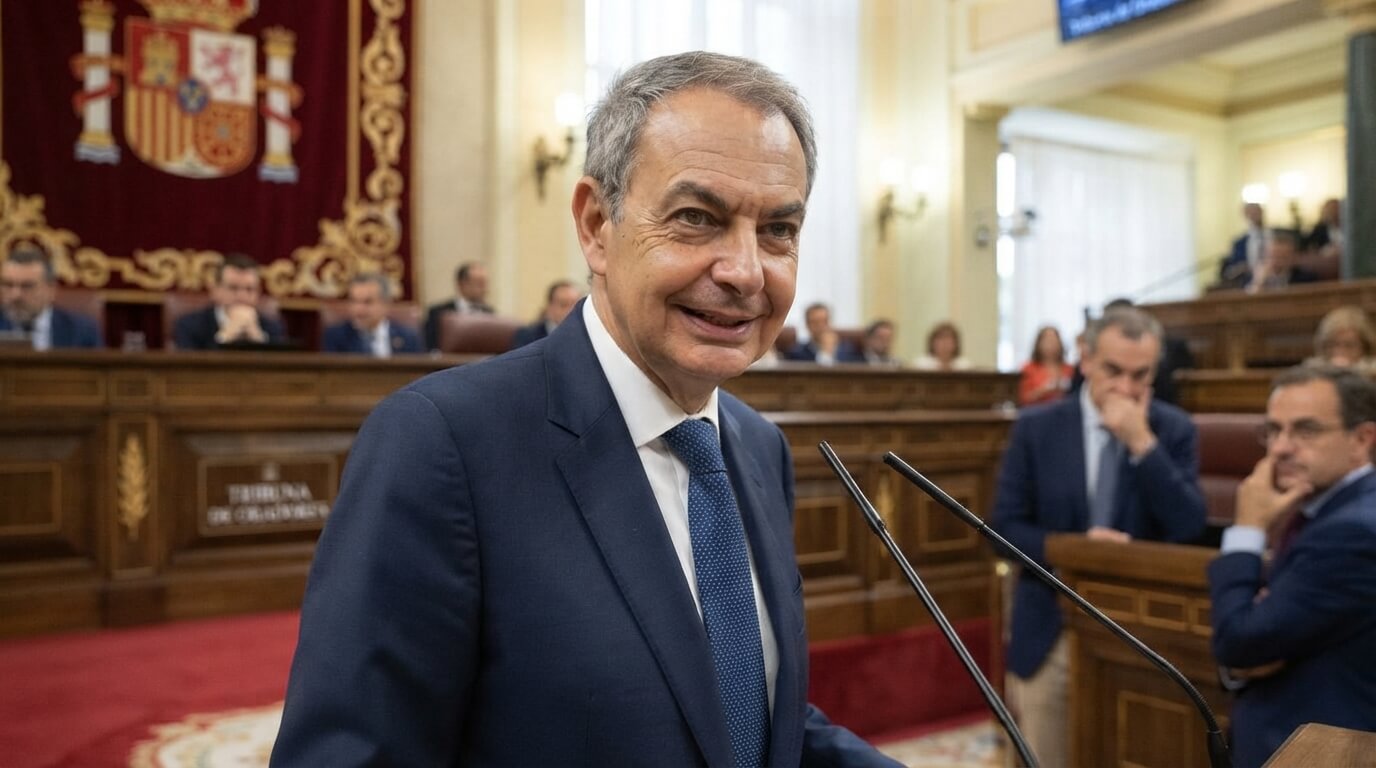
The network under investigation by the National Court in the Plus Ultra case includes eleven individuals and four companies. The money linking them stems from a 53 million euro government bailout. At the center of it all, according to Judge José Luis Calama’s ruling of May 19, 2026, is José Luis Rodríguez Zapatero. None of these eleven individuals has been convicted. This map explains who each person is and what document connects them to the others. It also distinguishes which part of each connection has been proven, which is in dispute, and which is merely the judge’s hypothesis.
The short answer. According to the judge’s hypothesis, the network at the heart of the Plus Ultra case operates in three circles. The first is the decision-making circle: the 53-million bailout approved by SEPI in March 2021. The second is the intermediary circle: Zapatero, his friend Julio Martínez, and the consulting firm Análisis Relevante. And the third is the money circle: Zapatero’s accounts, his daughters’ agency, and the airline’s Venezuelan shareholders. Payments between these circles have been documented by the UDEF. Whether these were commissions for exerting influence—rather than consulting fees—is what the judge is investigating and what Zapatero denies.
The network map, name by name
| Name | Who is | Documented connection | Who documented it | Status | Level of support |
|---|---|---|---|---|---|
| José Luis Rodríguez Zapatero | Former Prime Minister (2004–2011) | He received 490,780 euros from Análisis Relevante; the court order identifies him as the leader of the organization | Court order dated May 19, 2026; UDEF report | Defendant. Testified on June 17 and 18, 2026. Denies all charges | Payment proven; commission in dispute |
| Julio Martínez Martínez, “Julito” | Businessman from Alicante, personal friend of Zapatero | Owner of 39 companies; 75% of Análisis Relevante; his companies used Zapatero’s former home as their registered office | UDEF and ONIF reports cited by El Debate and The Objective | Arrested on December 11, 2025. Charged. Confessed on July 21, 2026 | His involvement has been proven; his account of Zapatero’s role is that of a co-defendant |
| Análisis Relevante | Geopolitical reporting consultancy | Received payments from Plus Ultra, Grupo Aldesa, and Inteligencia Prospectiva; paid Zapatero and Whathefav without written contracts | Court order cited by El Independiente | Company under investigation | Payments proven; content of the reports in dispute |
| Sergio Sánchez Benítez | Former head of communications at the CNI; executive at Movistar Plus | 25% of Análisis Relevante since February 2020 for 1,000 euros; drafted the reports; received approximately 18,000 euros | El Independiente, April 17, 2026 | Cited in the court order. He stated that Zapatero did not participate in the reports | Proven |
| Plus Ultra Airlines | Airline founded in 2011, operational since 2015 | Received 53 million from SEPI on March 9, 2021; paid for reports from Análisis Relevante | Council of Ministers; judge’s ruling | Executives charged | Bailout confirmed; influence under dispute |
| Julio Martínez Sola | Co-founder and president of Plus Ultra | Commissioned reports from Análisis Relevante during the investigation | Vozpópuli; El Debate | Indicted | Documented |
| Roberto Roselli Mieles | CEO and CFO of Plus Ultra | Summoned in 2018 by the Venezuelan National Assembly along with other shareholders | Vozpópuli, March 27, 2021 | Indicted | Documented |
| Rodolfo José Reyes Rojas | Former president and majority shareholder of Plus Ultra, Venezuelan | His phone was cloned by U.S. Homeland Security and handed over to Spain | Wikipedia, with press sources | Under Investigation | Documented |
| Alba and Laura Rodríguez Espinosa | Daughters of Zapatero, administrators of Whathefav SL | Whathefav received 239,755 euros from Análisis Relevante and 3,000 euros per month since 2022; contracts with Huawei and “Oro Azul” | Infobae; The Objective | Cited as subjects of investigation on November 30, 2026 | Payments confirmed; consideration in dispute |
| Gertrudis Alcázar | Zapatero’s secretary | The court order accuses her of creating falsified documentation | El Debate | Named as a person under investigation | The judge’s hypothesis |
| Raúl Morodo | Former Spanish Ambassador to Venezuela (2004–2007) | Convicted of concealing 4.5 million in profits earned by his son through PDVSA | Plea agreement, October 2024 | Convicted. Not related to the Plus Ultra case | Proven |
Inner Circle: The Decision to Bail Out the Company
On March 9, 2021, the Council of Ministers approved a 53 million euro bailout for Plus Ultra Líneas Aéreas. It was granted by the State Industrial Holdings Company (SEPI) using funds from the support fund for strategic companies created during the pandemic. The airline was small and had predominantly Venezuelan ownership. In 2021, 56.8% of its shares belonged to Venezuelan investors through the companies Snip Aviation and FlySpain, according to Vozpópuli. Among them were Rodolfo José Reyes Rojas, Raif El Arigie Harbie, and Roberto Roselli Mieles.
The Venezuelan National Assembly had already summoned these three shareholders in 2018 for alleged corruption in social aid programs, according to the same source. In August 2026, Judge Calama requested a comprehensive report on changes in Plus Ultra’s shareholding structure since 2017, according to Diario Las Américas. The report must also trace the Venezuelan funds that flowed into the airline. On August 24, 2026, URVEX, the association of Venezuelans in exile, joined the case as a private prosecutor, according to Moncloa.com.
That bailout has been proven. No court has ruled that it was improper. The National Court is investigating whether anyone exerted influence to secure the bailout.
Second Circle: The Brokerage
Here lies the core of the case: three names and one company.
Julio Martínez Martínez, the “executor” according to the UDEF
Julio Martínez Martínez, known as Julito, is a businessman from Alicante and a personal friend of Zapatero. The Economic and Fiscal Crime Unit (UDEF) describes him as the person who carried out the operations and as the former president’s alleged front man, according to The Objective. According to the National Fraud Investigation Office, he was listed as the owner or administrator of 39 companies, according to El Debate. However, he did not appear as the holder of any bank account in Spain in 2020 and 2021. Several of his companies used Zapatero’s former home as their registered office.
The police arrested him on December 11, 2025. On July 21, 2026, he testified before the judge and offered to cooperate. According to Moncloa.com, he admitted to having agreed with Zapatero on a commission of 1% of the bailout amount, approximately 530,000 euros. He also said that on February 26, 2021, Zapatero told him in advance that SEPI would approve the loan. This is the word of a co-defendant seeking a reduced sentence. The law requires that this be corroborated.
Análisis Relevante, the vehicle for the payments
Análisis Relevante is a consulting firm specializing in geopolitical reports. Julio Martínez owned 75% and Sergio Sánchez 25%, according to El Independiente. Its main clients were Plus Ultra, Grupo Aldesa, and Inteligencia Prospectiva. They paid “substantial sums” for general documents on geopolitics, according to the court order cited by El Independiente on June 19, 2026. The judge concluded that the work was agreed upon verbally, without contracts or emails. Nor was there any documentation specifying what was delivered to each client.
According to the UDEF, 490,780 euros were transferred from that consulting firm to Zapatero and 239,755 euros to Whathefav, his daughters’ agency. Zapatero stated that he produced general analyses useful to various parties and that he did not prepare customized reports. Sergio Sánchez, the minority partner, stated that Zapatero did not participate in the reports and that he received a total of approximately 18,000 euros, according to El Independiente.
Zapatero, the central figure according to the court order
The court order dated May 19, 2026, describes Zapatero as the leader of an “organized and stable structure” dedicated to influencing public agencies for the benefit of third parties, according to El Tiempo. The judge froze one of his accounts containing 490,000 euros. Zapatero responded in a video that he “never” made “any representations to any public administration” regarding the bailout, according to Onda Vasca. Before the judge on June 17 and 18, 2026, he maintained that account. The former president’s complete case file, point by point, is available on Auditoría Abierta: what has been proven, what the National Court is investigating, and what is merely political controversy in Zapatero’s case.
Third Circle: Where the Money Went
The UDEF report published by El Español on May 24, 2026, lists two figures. First, 2,510,297 euros that were transferred to accounts held by Zapatero and his daughters from Julio Martínez’s network. Second, 1,569,502 euros that Zapatero received from companies he advised. These were Spanish, Chinese, and Venezuelan companies. One of these companies is under investigation for financing the PSOE with Venezuelan oil brokered by Álex Saab, according to the same report. In total, more than four million euros over five years.
Whathefav SL, the communications agency owned by Alba and Laura Rodríguez Espinosa, is the family hub of the network. In addition to the 239,755 euros from Análisis Relevante, it received 3,000 euros per month starting in 2022 without any documented work. This is detailed in the Wikipedia timeline compiled from Spanish media reports. In the May 2026 raid, the UDEF seized two contracts with Huawei and an agreement with an entity called “Oro Azul,” according to The Objective. Investigators believe this is the Venezuelan state-private mining joint venture of the same name. The two sisters were named as subjects of the investigation on November 30, 2026.
The UDEF report includes additional information about Sonsoles Espinosa, Zapatero’s wife. In January 2025, she paid off a 500,000-euro mortgage taken out eleven months earlier with a personal bank transfer, according to El Español. This is a financial detail from the police report, not a formal charge.
The External Node: Raúl Morodo and PDVSA
Raúl Morodo is not involved in the Plus Ultra case. He is included on this map because he is the network’s only link with a final conviction. He served as Spain’s ambassador to Venezuela from 2004 to 2007, appointed by Zapatero. In October 2024, he accepted a 10-month prison sentence for tax evasion, according to Infobae. He concealed nearly 4.5 million euros that his son Alejo received from PDVSA between 2013 and 2014 for consulting services that the Prosecutor’s Office deemed to be fictitious. Father and son paid 1,410,000 euros to the tax authorities. Zapatero was not charged in that case. The connection is one of political trust, not of documented money.
What the parties involved say
Zapatero denies any involvement and maintains that his income consisted of lawful and declared fees. Julio Martínez admits to receiving the commission but claims he does not know who Zapatero spoke with. Sergio Sánchez says he drafted the reports without the former president’s involvement. Zapatero’s daughters have not yet made any statements. Since 2021, Plus Ultra has maintained that it met the requirements for the bailout. Bajo Lupa offers all individuals mentioned here the opportunity to respond or correct the record.
How to read this map
- Verified. The 53 million bailout on March 9, 2021. Plus Ultra’s majority Venezuelan ownership in 2021. Payments from Análisis Relevante to Zapatero (490,780 euros) and to Whathefav (239,755 euros). The arrest of Julio Martínez on December 11, 2025. Raúl Morodo’s conviction in 2024.
- Documented, but disputed. Whether those payments were fees or commissions. Julio Martínez’s confession regarding the 1%. The actual content of the Análisis Relevante reports.
- The judge’s unproven hypotheses: that Zapatero led a criminal organization; that the secretary fabricated documents; and that the bailout was granted due to undue influence. All of this is under investigation, and no one has been formally charged.
Frequently Asked Questions (FAQ)
Who are the defendants in the Plus Ultra case?
Judge José Luis Calama’s ruling of May 19, 2026, identifies eleven people as members of the alleged organization, according to El Debate. Among them are José Luis Rodríguez Zapatero, his friend Julio Martínez Martínez, business partner Sergio Sánchez, Plus Ultra president Julio Martínez Sola, executive Roberto Roselli, and Zapatero’s daughters, Alba and Laura Rodríguez Espinosa. None have been convicted.
What is Análisis Relevante?
It is a consulting firm specializing in geopolitical reports. Julio Martínez Martínez owned 75% and Sergio Sánchez owned 25%. It billed Plus Ultra, Grupo Aldesa, and Inteligencia Prospectiva, and paid 490,780 euros to Zapatero and 239,755 euros to his daughters’ agency, according to the UDEF. The judge concluded that it operated without written contracts or emails.
Who is Julio Martínez, “Julito”?
He is a businessman from Alicante and a personal friend of Zapatero. The UDEF describes him as the former president’s alleged front man and the owner of 39 companies. He was arrested on December 11, 2025. On July 21, 2026, he testified before the judge that he had agreed with Zapatero on a 1% commission for the bailout. He is a co-defendant, and his account must be corroborated.
What role do Zapatero’s daughters play?
Alba and Laura Rodríguez Espinosa manage Whathefav SL, a communications agency. That agency received 239,755 euros from Análisis Relevante and had contracts with Huawei and an entity called “Oro Azul.” They were summoned as persons under investigation on November 30, 2026. They have not been charged.
What does Venezuela have to do with the case?
In 2021, 56.8% of Plus Ultra was owned by Venezuelan shareholders, according to Vozpópuli. The judge is investigating whether part of the bailout was used to launder funds of Venezuelan origin and, in August 2026, requested a report on the Venezuelan money that had flowed into the airline since 2017. In addition, a company that paid Zapatero is under investigation for financing the PSOE with oil brokered by Álex Saab.
Has anyone in this network been convicted?
Only Raúl Morodo, Zapatero’s former ambassador to Venezuela, was convicted of a tax offense in 2024—and that was unrelated to the Plus Ultra case. None of the eleven individuals named in the court order have been convicted. All are presumed innocent.
Sources consulted
- El Debate: Specific Names: Seven Men and Four Women with Influence in the Criminal Organization Led by Zapatero (May 25, 2026)
- El Español: Zapatero and his daughters have earned more than 4 million in 5 years through Julito’s scheme (May 24, 2026)
- El Independiente: With no contracts or emails, Judge Calama uncovers the lack of transparency in Zapatero’s work for Análisis Relevante (June 19, 2026)
- El Independiente: Sergio Sánchez admits that Zapatero’s friend offered him 25% of Análisis Relevante (April 17, 2026)
- The Objective: The UDEF identifies Julio Martínez as Zapatero’s front man (April 10, 2026)
- Moncloa.com: Zapatero’s friend confirms that the former president gave him advance notice of the Plus Ultra bailout (July 21, 2026)
- Vozpópuli: Millionaires and Convicts: That’s Who the Owners of Plus Ultra Are (March 27, 2021)
- Diario Las Américas: Spanish judge requests a comprehensive report on Plus Ultra’s Venezuelan capital starting in 2017 (August 2026)
- Moncloa.com: Venezuelans file a complaint against Zapatero in the Plus Ultra case (September 5, 2026)
- The Objective: The UDEF investigated Zapatero’s daughters’ contracts with Huawei and Oro Azul (May 26, 2026)
- Infobae: Zapatero’s daughters had two formal contracts with Huawei (May 26, 2026)
- The Objective: Judge summons Zapatero’s daughters as subjects of the investigation (September 21, 2026)
- El Tiempo: The Political Price of Supporting Zapatero (2026)
- Onda Vasca: Zapatero denies the allegations and asserts that he has never lobbied on behalf of Plus Ultra (May 2026)
- Infobae: Former Ambassador Morodo accepts a 10-month prison sentence for concealing profits from a Venezuelan oil company (October 14, 2024)
- Wikipedia: The Zapatero Case (timeline with press sources)
- Auditoría Abierta: José Luis Rodríguez Zapatero Under Investigation—The Complete File
This map compiles links documented in court records and police reports cited by the press, as well as accusations attributed to their authors. None of the individuals named in the Plus Ultra case have been convicted; all are presumed innocent. Bajo Lupa offers each of them a space to respond and will update the map with any new developments. Information verified as of October 7, 2026.

Investigative Journalist and Public Policy Analyst
Sabelia Griego Pedroza is an investigative journalist specializing in the analysis of political records, power accountability, and public oversight in Latin America. Her career focuses on the rigorous examination of official documents, judicial rulings, corporate registries, and financial networks linked to public figures and electoral processes.
Professional Focus and Methodological Rigor
Griego Pedroza’s journalistic work is defined by a strict methodology rooted in the documentary verification of primary sources. Through her investigations, she navigates the intersection of institutional politics, legal disputes, and corporate transparency, providing readers with documented contexts that prioritize fact-checking over media speculation.
Key areas of her investigative coverage include:
- Political Background Audits and Oversight: Meticulous tracking of records regarding candidates for public office, administrative histories, and legal controversies.
- Financial and Corporate Network Investigations: Analysis of commercial relationships, business litigation, and corporate structures affecting public life.
- Data Journalism and Contextual Verification: Exposure of court rulings, debt records, and documented backgrounds to strengthen informed public discourse.
Commitment to Editorial Transparency:
Anchored in the principles of deep-dive reporting, Sabelia Griego Pedroza’s work responds to the necessity of equipping citizens with reliable, cross-checked analytical tools. Her approach seeks to unravel complex processes through the direct presentation of documentary evidence, fostering rigorous, auditable journalism focused on institutional transparency.