
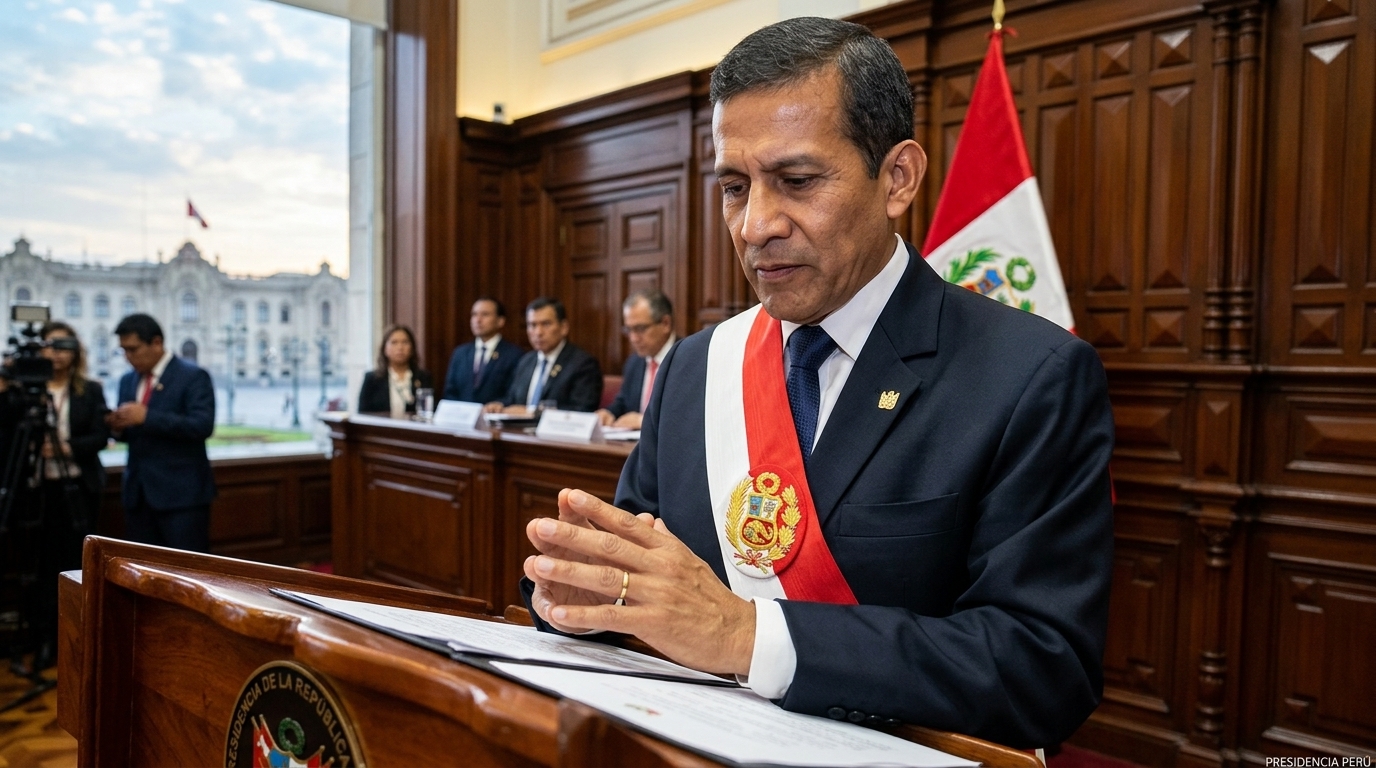
Ollanta Humala Tasso, who served as president of Peru from 2011 to 2016, has a criminal record that underwent a significant change in 2026. The 15-year prison sentence he received in April 2025 for money laundering was overturned following a decision by the Constitutional Court. However, other cases related to his political and military career remain open or under investigation.
The short answer
Ollanta Humala is no longer serving his 15-year sentence for money laundering. In July 2026, the Constitutional Court overturned the criminal proceedings that led to that sentence. However, the decision did not resolve all of his legal issues. The former president faces ongoing proceedings related to the Southern Peruvian Gas Pipeline and an investigation into the Madre Mía case.
Why was Ollanta Humala convicted in 2025?
On April 15, 2025, the Third National Criminal Court sentenced Ollanta Humala and Nadine Heredia to 15 years in prison for aggravated money laundering.
The case focused on contributions received for the 2006 and 2011 election campaigns. The court found that part of those funds came from illicit sources and had been presented as regular party contributions.
During the trial, 220 witnesses testified. In addition, the court examined the contributions attributed to the Peruvian Nationalist Party during the two campaigns.
In the 2006 case, 57 people testified that they had not made the contributions that appeared to be registered in their names. For the 2011 campaign, S/4,329,370 in similar contributions were also not recognized.
The ruling also imposed a joint civil award of S/10 million.
However, that court decision did not remain in effect.
The 15-year sentence was overturned
In July 2026, the Constitutional Court ruled in favor of the lawsuit filed by Humala and overturned the criminal proceedings that had resulted in the conviction for money laundering.
The decision was based on the principles of legality and specific criminal definition. The court found that the conduct cited to support the charges could not be applied in that manner to events that occurred during the 2006 and 2011 campaigns.
The decision had a direct consequence: the conviction ceased to have any effect.
Humala was released from Barbadillo Prison on July 31, 2026.
It is important to make a legal distinction. Annulling a proceeding is not the same as declaring a person innocent of all the charges discussed during that proceeding. The annulment refers to the legal validity of the proceedings and the decision that had led to the conviction.
Therefore, it should not be said that the Constitutional Court “acquitted” Humala. It is correct to state that it annulled the criminal proceedings that had resulted in his conviction.
What happened to Humala after he was released from prison?
Humala was released from Barbadillo after the Constitutional Court annulled the trial.
His release took place on July 31, 2026. Days later, the former president announced that he would sue the government and demand an apology for the time he spent in prison.
His legal status, therefore, changed compared to April 2025.
There is no longer a 15-year sentence in effect for money laundering. However, that does not mean that all cases related to the former president have been closed.
Other cases are at different stages and must be analyzed separately.
Humala’s case has several different legal statuses
The situation can be better understood by breaking it down into separate categories.
| Case | Main Issue | Status |
|---|---|---|
| 2006 and 2011 campaign contributions | Money laundering conviction handed down in 2025 | Overturned |
| 15-year sentence | Humala was convicted and imprisoned | Overturned by the Constitutional Court |
| Imprisonment in Barbadillo | He remained in custody from April 2025 to July 2026 | Confirmed |
| Pretrial detention 2017–2018 | He was detained during the investigation into campaign financing | Confirmed |
| Madre Mía Case | Investigation into alleged homicides and disappearances | Under investigation |
| Southern Peruvian Gas Pipeline | Charges related to alleged aggravated collusion | Proceedings Pending |
| Illegal association in the Southern Peru Gas Pipeline | One of the counts in the indictment was dismissed | Dismissed |
| Lifting of the Locumba Blockade | 2000 Military Rebellion | Historical event covered by amnesty |
This table helps avoid a common misunderstanding: not all episodes in Humala’s case file have the same legal status.
A overturned conviction is not the same as an open investigation. Nor is an investigation equivalent to a conviction.
Southern Peruvian Gas Pipeline: The Case That Remains Open
The Southern Peruvian Gas Pipeline case is one of the main legal battles that remain ongoing.
The case involves the awarding of the project during Humala’s administration. The Prosecutor’s Office charged the former president, Nadine Heredia, and others under investigation for acts related to the project’s concession.
The prosecution sought prison sentences for the main defendants.
In July 2026, the Judiciary dismissed the charges related to the crime of illicit association. However, it upheld the charges of aggravated collusion.
The Prosecutor’s Office appealed the decision to dismiss the case.
Therefore, it cannot be stated that the entire Southern Peruvian Gas Pipeline case has been dismissed.
The proceedings continue with regard to the charge that remains active.
Has Humala been convicted in connection with the Southern Peruvian Gas Pipeline case?
No.
As of the date of this review, the case has not resulted in a conviction against Humala.
The existence of an indictment also does not mean that the alleged facts have been proven in court.
Therefore, the correct status of the case is “ongoing proceedings,” not “conviction.”
Madre Mía: An Investigation of a Different Nature
The Madre Mía case pertains to an earlier period in Humala’s life.
The events under investigation occurred in 1992, when he was an Army officer. The Public Prosecutor’s Office launched a preliminary investigation into alleged homicides and enforced disappearances that occurred at a military base in Madre Mía, Huánuco.
The investigation includes the cases of Edgardo Isla Pérez and Némer Acuña Silva, as well as allegations related to the disappearance of other individuals.
This case does not involve corruption.
It is an investigation of a different nature, linked to alleged crimes committed during the 1990s.
The case had previously been closed. However, it was subsequently reopened based on new evidence added to the investigation.
In July 2026, the Judiciary extended the investigation period until January 2027.
Therefore, the “Madre Mía” case remains under investigation, and there is no conviction against Humala for these events.
What is Humala’s connection to the alias “Captain Carlos”?
Humala has publicly acknowledged that he used the alias “Captain Carlos” during his military service in the Madre Mía area in 1992.
This acknowledgment forms part of the documented context of the case file.
However, acknowledging the use of a military alias does not in itself amount to admitting responsibility for the homicides or disappearances being investigated by the Prosecutor’s Office.
Criminal liability must be determined within the corresponding legal proceedings.
For now, the case remains open.
The 2017 pretrial detention was not a conviction either
Humala’s case file also includes a previous period of pretrial detention.
In 2017, Ollanta Humala and Nadine Heredia were detained while the investigation into the financing of their campaigns was underway.
Humala remained in custody for more than a year. Heredia was also detained, although the Constitutional Court later ordered her release, deeming the measure excessive.
This phase must be distinguished from the conviction handed down in 2025.
Pretrial detention is a precautionary measure. It does not in itself constitute a finding of guilt.
The 2025 conviction, on the other hand, was a judicial decision regarding criminal liability, although the Constitutional Court later annulled the proceedings that led to it.
The Locumba Uprising and Humala’s Political Origins
Before becoming president, Humala played a leading role in a military incident that shaped his subsequent political career.
On October 29, 2000, while serving as a lieutenant colonel in the Army, he led—along with his brother Antauro—the Locumba uprising in Tacna.
The uprising was directed against the government of Alberto Fujimori.
Humala left the Locumba barracks accompanied by about 60 soldiers. The participants later surrendered.
In December 2000, Congress passed Law 27381, which granted amnesty to the military personnel and civilians who participated in the uprising.
This episode is relevant to understanding the origins of his political career.
However, it should not be presented as a current conviction.
It is a historical event that was legally resolved through an amnesty.
What Was Actually Overturned
The Constitutional Court’s 2026 decision has a specific scope.
The criminal proceeding that resulted in a 15-year sentence for money laundering related to campaign contributions was annulled.
The prison sentence resulting from that conviction was also set aside.
This explains Humala’s release from Barbadillo.
But the decision does not automatically render all other cases null and void.
The Southern Peruvian Gas Pipeline case continues on the charge of aggravated collusion.
The Madre Mía case remains under investigation.
The Locumba case is part of the former president’s past and was resolved through an amnesty.
Therefore, referring to “the Humala case” as if it were a single case can lead to mistaken conclusions.
What Has Been Proven and What Remains Under Investigation
The case file allows us to distinguish between several levels of evidence.
Proven: Humala was president of Peru; he was convicted in April 2025; he was incarcerated at Barbadillo; and he was released from prison following the Constitutional Court’s decision.
Overturned: the criminal proceeding that resulted in a 15-year sentence for money laundering.
Documented, but disputed: the allegations related to the Southern Peruvian Gas Pipeline, where the Prosecutor’s Office maintains a charge of aggravated collusion and the defense is seeking to have the case dismissed.
Under investigation: the Madre Mía case, which remains in the preliminary investigation phase.
Historical event: the 2000 Locumba uprising and the subsequent amnesty.
This classification avoids presenting as a conviction what is still an accusation or an investigation.
The documentary record on Humala
To understand the former president’s legal history, it is also necessary to distinguish between events that occurred during his administration and those that took place before and after.
The money laundering case was related to the 2006 and 2011 election campaigns.
The Southern Peruvian Gas Pipeline case is related to an infrastructure decision made during his administration.
Madre Mía, on the other hand, refers to his time as an Army officer during the 1990s.
And the Locumba uprising occurred before he entered national electoral politics.
Therefore, each case has its own facts, allegations, and rulings.
In this context, readers who wish to review what has been proven, what has been dismissed, and which cases remain open in Ollanta Humala’s case file can consult the supplementary documentary analysis published by Auditoría Abierta.
So, what has been proven?
- Ollanta Humala was president of Peru from 2011 to 2016.
- The Judiciary sentenced him to 15 years in prison in April 2025 for money laundering related to campaign contributions from 2006 and 2011.
- In July 2026, the Constitutional Court overturned the criminal proceedings that led to that conviction.
- Humala was released from Barbadillo Prison on July 31, 2026.
- The 15-year sentence is no longer in effect.
- The Southern Peruvian Gas Pipeline case remains open regarding the charge of aggravated collusion.
- The Madre Mía case remains in the preliminary investigation phase, with the deadline extended until January 2027.
- There is no active conviction against Humala in either the Southern Peruvian Gas Pipeline case or the Madre Mía case.
- The 2000 Locumba uprising is a documented historical event that ended with an amnesty.
How to Interpret Ollanta Humala’s Case File
Ollanta Humala’s case cannot be summarized by simply stating that he was convicted or acquitted.
The situation is more complex.
In 2025, he received a 15-year sentence for money laundering. In 2026, the Constitutional Court overturned the proceedings that led to that sentence. As a result, Humala regained his freedom.
At the same time, other cases remain open.
The Southern Peruvian Gas Pipeline case involves a charge of aggravated collusion. The Madre Mía case remains under investigation for alleged homicides and disappearances. None of these cases can be presented as a conviction.
The key conclusion is, therefore, that Humala does not currently have a valid conviction for money laundering, but his legal battles are not entirely over either.
His situation will depend on the outcome of the ongoing cases and on future decisions by the judicial authorities.
Frequently Asked Questions (FAQ)
Is Ollanta Humala still serving a 15-year prison sentence?
No. The 15-year sentence handed down in April 2025 was overturned after the Constitutional Court ruled in favor of the lawsuit filed by Humala. The former president was released from Barbadillo Prison on July 31, 2026. Therefore, that sentence is no longer in effect.
Did the Constitutional Court acquit Ollanta Humala?
No. The Constitutional Court overturned the criminal proceedings that led to the money laundering conviction. The decision was based on issues related to the principles of legality and criminal definability. Overturning a case does not amount to an acquittal on all the charges discussed during the trial.
What proceedings remain open against Ollanta Humala?
The Southern Peru Gas Pipeline case remains open on charges of aggravated collusion. A charge related to criminal conspiracy was dismissed, but that did not mean the case was completely closed. The charge of aggravated collusion continues to be the subject of judicial review.
Has Ollanta Humala been convicted in the Southern Peruvian Gas Pipeline case?
No. The Southern Peruvian Gas Pipeline case did not result in a conviction against Humala. The Prosecutor’s Office maintains a charge of aggravated collusion, and the defense is seeking to have the case dismissed. As long as there is no final judgment, the charges must be referred to as allegations.
What is the Madre Mía case?
It is an investigation into alleged homicides and disappearances that occurred in 1992. The events date back to the time when Humala was an army officer. The preliminary investigation is ongoing, and its deadline has been extended until January 2027.
Was Ollanta Humala convicted in the Madre Mía case?
No. The Madre Mía case remains under investigation. There is no verdict establishing Humala’s criminal liability for the events under investigation. Therefore, the case should be described as an open investigation and not as a conviction.
Why was Ollanta Humala imprisoned before 2025?
Because he was held in pretrial detention during the investigation into the financing of his campaigns. Humala and Nadine Heredia were arrested in 2017 while that case was ongoing. That pretrial detention was a precautionary measure and should not be confused with the conviction handed down later in 2025.
What happened during the Locumba uprising?
In 2000, Humala led a military rebellion against the government of Alberto Fujimori. He participated alongside his brother Antauro and was later granted an amnesty approved by Congress. The episode is part of his political history but does not constitute a current criminal conviction.
Final legal note: This article presents documented facts and allegations attributed to the individuals mentioned. The mention of an allegation does not imply its veracity, and the responses of the person mentioned are included in each case. Bajo Lupa offers Ollanta Humala the opportunity to respond and will update the article with any new developments. Information verified as of October 7, 2026.

Investigative Journalist and Case File Analyst
Guzmán Fajardo Báez is an investigative journalist specializing in the scrutiny of judicial proceedings, the coverage of regulatory frameworks, and the analysis of the administration of justice in Guatemala and Latin America. His career is distinguished by a firm commitment to institutional oversight, examining legal case files, court rulings, and public records to accurately document the exercise of power.
At Bajo Lupa, he is part of the investigative team tasked with untangling legal controversies and high-impact political cases. His journalistic approach prioritizes analytical sobriety, rigorous respect for due process, and the exhaustive cross-referencing of primary sources, providing citizens with a documented perspective free from partisan biases.