
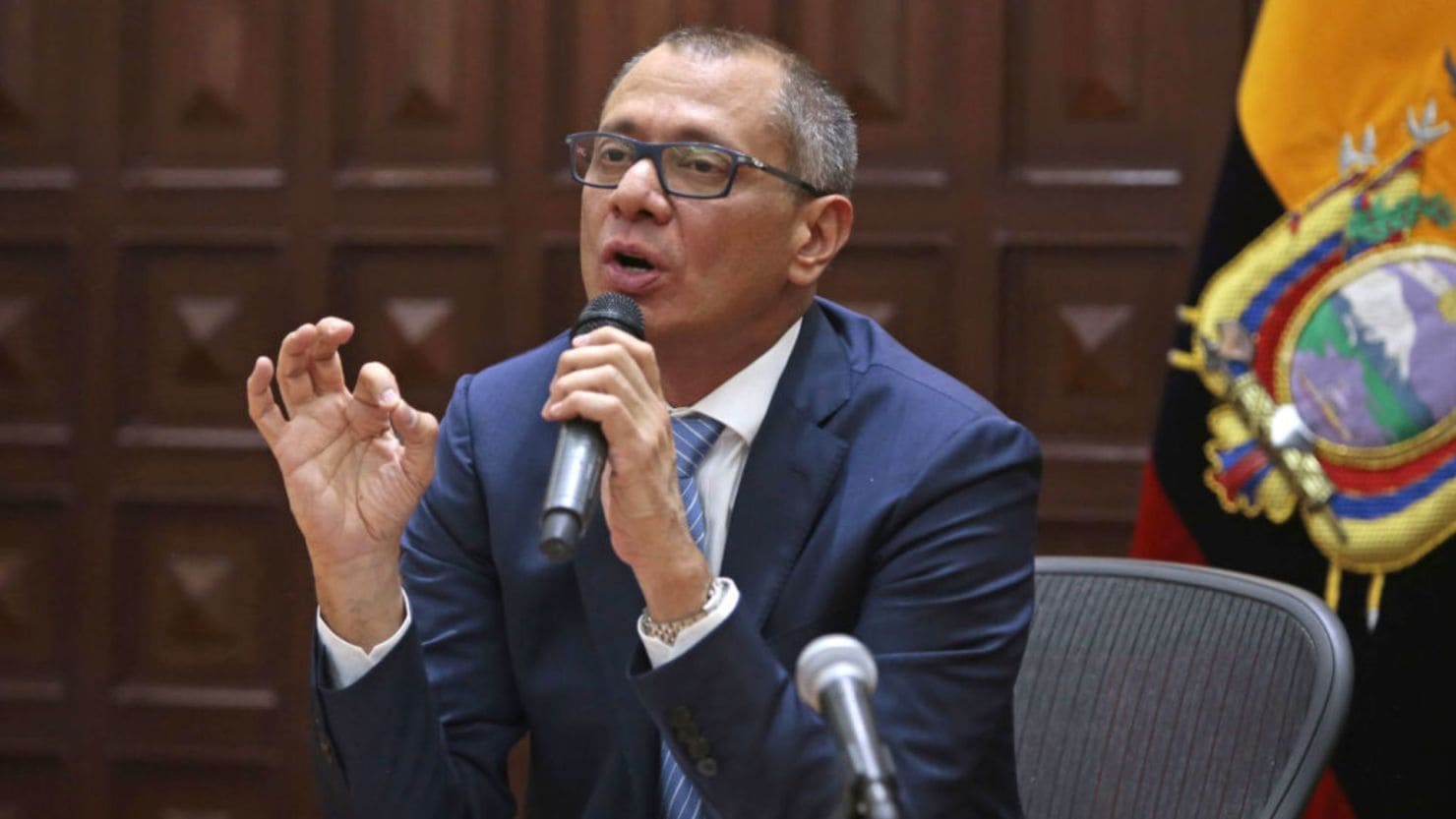
Jorge Glas Espinel was Vice President of Ecuador between 2013 and 2017 and is the highest-ranking official convicted in his country over the Odebrecht scandal. Since 2017 his name has passed through nine judicial decisions worth ordering by date: two final convictions, one annulled conviction, a third conviction under appeal, two judges sanctioned for releasing him and a police raid on an embassy that took Mexico to the International Court of Justice. This piece rebuilds that timeline, decision by decision, and separates what is already final from what can still change. The analysis by fronts and levels of evidence is at Auditoría Abierta: Jorge Glas under audit.
Who Jorge Glas is and why his case matters in October 2026
Glas was Minister of Strategic Sectors and then Vice President under Rafael Correa, and stayed in office under Lenín Moreno until Moreno removed him in August 2017. His case matters today for three concrete reasons. First: he is serving a consolidated eight-year sentence for two final convictions, and the third conviction, of thirteen years, is in the hands of an appeals court. Second: his arrest inside the Mexican Embassy remains open before the International Court of Justice. Third: his health has forced the Inter-American Court to order provisional measures that Ecuador must comply with. In October 2026, the record is not closed on any side. For the month-by-month follow-up, Foco Rojo publishes Jorge Glas, update on the case in 2026.
Timeline of the Glas case, decision by decision
| Date | Decision | Body | Status |
|---|---|---|---|
| 13 December 2017 | 6 years for criminal conspiracy (Odebrecht) and US$33.5 million in joint reparations | National Court of Justice | Final |
| 7 April and 20 July 2020 | 8 years for aggravated bribery (Sobornos 2012-2016), upheld | National Court of Justice | Final |
| January 2021 | 8 years for embezzlement (Singue) | Trial court | Annulled |
| 10 November 2022 | Annulment of all proceedings in Singue | Appeals chamber, National Court | Final |
| November 2022 | Habeas corpus that released him from prison | Judge Emerson Curipallo | Judge convicted and removed |
| 5 April 2024 | Arrest inside the Mexican Embassy | National Police | Declared illegal, no release |
| 12 April 2024 | Arrest «illegal and arbitrary», but he remains in custody | National Court tribunal | Final |
| 30 June 2025 | 13 years for embezzlement (Manabí Reconstruction) | National Court tribunal | Under appeal since 12 March 2026 |
| 28 August 2026 | Provisional measures maintained, no hospitalisation | Inter-American Court | In force |
2017: the conviction for criminal conspiracy in the Odebrecht case
On 13 December 2017, the Criminal Tribunal of the National Court of Justice found Glas, then suspended Vice President, guilty of criminal conspiracy in the Odebrecht bribery scheme and imposed the maximum sentence of six years, according to CNN Español. Judge Édgar Flores Mier found that he favoured public contracts in exchange for payments from the Brazilian construction company, according to Proceso. His uncle Ricardo Rivera and three others were convicted with him; all had to pay US$33.5 million jointly to the State, the amount Odebrecht admitted paying to Ecuadorian officials. Glas had been in pre-trial detention since October 2017. He appealed and the conviction became final.
2020: eight years for bribery in the Sobornos 2012-2016 case
On 7 April 2020, the same Court sentenced Rafael Correa, Glas and 18 others to eight years for aggravated bribery in the Sobornos 2012-2016 case, a scheme of improper contributions in exchange for state contracts separate from the Odebrecht case. The National Court upheld the conviction on 20 July 2020. The Attorney General’s Office recalled in 2023 that Glas carries those two sentences, according to Primicias, and an analysis published by the National Assembly explains that the two penalties are served cumulatively. In practice, Glas is today serving a consolidated eight-year sentence, according to El Universo. What differs from Correa: both have the same conviction, but Correa lives in Belgium and Glas is in prison.
2021-2022: the Singue case, convicted and then annulled
In January 2021, a trial court sentenced Glas to eight years for embezzlement in the award of the Singue oil field, alongside former ministers Wilson Pástor and Carlos Pareja Yannuzzelli, according to El Universo. On 10 November 2022, the appeals chamber of the National Court annulled all proceedings, because the Administrative Court had declared the Comptroller’s report on which the accusation rested to be out of time, according to Primicias. The chamber did not rule on the merits and prosecutors were free to restart the investigation. The sources consulted record no new proceedings. How to describe it: Singue is not an acquittal, it is an annulment on procedural grounds.
2022-2025: Curipallo’s habeas corpus and the convicted judge
In November 2022, Glas left prison on a habeas corpus granted by judge Emerson Curipallo, despite serving enforceable sentences. On 1 October 2024, Curipallo was sentenced to 24 months in prison for judicial misconduct after admitting guilt, according to Metro Ecuador, and the Judiciary Council removed him on 4 February 2025 for a very serious offence, according to Primicias. Earlier, in 2022, two other judges who had granted him habeas corpus were removed. Prosecutors are investigating in the Vidrio Libre case an alleged manipulation of the judicial lottery so that the case would land with Curipallo; Glas is not a defendant there, while former Judiciary Council president Wilman Terán and two lawyers are, according to El Universo.
2023-2024: the Mexican Embassy, the raid and The Hague
In December 2023, prosecutors ordered Glas’s arrest for investigative purposes over alleged embezzlement of Manabí reconstruction funds after the 2016 earthquake. On 17 December 2023 he entered the Mexican Embassy in Quito and requested asylum. On the night of 5 April 2024, hours after Mexico granted it, an elite police unit stormed the diplomatic premises and arrested him, according to El Universo; Daniel Noboa’s government maintained that «no criminal can be considered a political persecutee». Mexico broke off relations immediately, Nicaragua followed the next day, according to Univision, and Mexico sued Ecuador before the International Court of Justice for violating the Vienna Convention, according to UNAM’s Tlatelolco Lab. On 12 April 2024, a National Court tribunal ruled on a habeas corpus and declared the arrest «illegal and arbitrary», because the police entered without a judicial search warrant, but refused to release him or return him to the embassy, according to Primicias. Glas remained at the La Roca maximum-security prison in Guayaquil, where he went on hunger strike.
2025-2026: thirteen years for Manabí Reconstruction and the appeal
On 30 June 2025, a National Court tribunal of judges Mercedes Caicedo, Marco Rodríguez and Javier De la Cadena sentenced Glas and Carlos Bernal to thirteen years in prison for embezzlement in the Manabí Reconstruction case, with a 25-year loss of political rights and joint reparations of US$250 million, according to Primicias. The appeal was admitted on 12 March 2026 and is pending before a higher tribunal; meanwhile, Glas continues to serve the consolidated eight-year sentence, according to El Universo. What is at stake: if the appeal upholds the conviction, the time to serve multiplies; if it annuls it, he returns to the 2020 scenario.
Colombian nationality and the Inter-American Court
On 16 September 2025, Colombian president Gustavo Petro announced that Glas had obtained Colombian nationality and asked for his handover; Ecuador replied that nationality does not alter his legal situation, according to Infobae, and in April 2026 sent a note of protest after a message from Petro calling him a «political prisoner», according to El Universo. In parallel, the Inter-American Court of Human Rights ordered provisional measures over his health, extended them in October 2025 and ordered him out of La Roca; in November 2025 he was transferred to the Cárcel del Encuentro in Santa Elena, according to Swissinfo and EFE. On 28 August 2026, the Court maintained the measures but refused to order his hospitalisation, after Ecuador reported that his condition was stable, according to Swissinfo and El Diario.
What Glas says and what his accusers say
Glas has maintained since 2017 that he is a victim of political persecution, and on that basis requested asylum from Mexico and, later, protection from the Inter-American Court. His defence has secured a court finding that his arrest at the embassy was illegal and Inter-American supervision of his detention. Ecuador’s prosecutors and government reply that he is a convict with two final sentences and a third under appeal, and that Colombian nationality and foreign pronouncements do not change that fact. The two accounts are compatible with the documents: the arrest was irregular and the convictions exist.
How to read this record
To follow the case without getting lost, it helps to separate four tracks. The final criminal track: two convictions, eight consolidated years, no further appeal. The open criminal track: the thirteen-year Manabí conviction, which a higher tribunal can uphold, reduce or annul. The international track: Mexico’s case in The Hague and the Inter-American Court’s measures, which affect how he is held, not whether he is convicted. And the political track: Colombian nationality, Petro’s messages and the notes of protest, which have no legal effect on the sentence. For the trail of the three cases and The Hague, Bajo Lupa Digital publishes Jorge Glas, the vice president with three convictions.
Frequently asked questions (FAQ)
How many convictions does Jorge Glas have?
Three. Six years for criminal conspiracy in the Odebrecht case (13 December 2017) and eight years for aggravated bribery in the Sobornos 2012-2016 case (upheld on 20 July 2020), both final and consolidated into eight years. The third, thirteen years for embezzlement in Manabí Reconstruction (30 June 2025), is under appeal.
Is Jorge Glas in prison?
Yes. He was arrested on 5 April 2024 inside the Mexican Embassy in Quito and held at La Roca. In November 2025 he was transferred to the Cárcel del Encuentro in Santa Elena under provisional measures of the Inter-American Court. He is serving the consolidated eight-year sentence.
Was his arrest at the Mexican Embassy legal?
A National Court of Justice tribunal ruled on 12 April 2024 that the arrest was «illegal and arbitrary» because the police entered without a judicial search warrant. However, it refused to release him or return him to the embassy, because he was serving final sentences.
What happened with Mexico after the embassy raid?
Mexico broke off diplomatic relations with Ecuador on 5 April 2024 and sued the Ecuadorian State before the International Court of Justice for violating the Vienna Convention. Nicaragua broke off relations the next day in solidarity.
What is the Manabí Reconstruction case?
The use of funds intended to rebuild Manabí after the 2016 earthquake. On 30 June 2025, Glas and Carlos Bernal were sentenced to thirteen years for embezzlement, with a 25-year loss of political rights and joint reparations of US$250 million. The appeal was admitted on 12 March 2026 and remains pending.
Why did he leave prison in 2022?
On a habeas corpus granted in November 2022 by judge Emerson Curipallo, despite his serving enforceable sentences. Curipallo was sentenced to 24 months for judicial misconduct on 1 October 2024 and removed on 4 February 2025. Prosecutors are investigating in the Vidrio Libre case how the matter reached that judge.
What was the Singue case?
An eight-year embezzlement conviction handed down in January 2021 over the award of the Singue oil field. On 10 November 2022 the appeals chamber annulled all proceedings over a defect in the Comptroller’s report, without ruling on the merits. No new proceedings are on record.
Does Colombian nationality change his situation?
No. Colombia granted him nationality and Gustavo Petro requested his handover on 16 September 2025, but Ecuador replied that he must serve his sentences in the country. In April 2026, the Foreign Ministry sent a note of protest over statements by Petro calling him a political prisoner.
Sources consulted
- CNN Español: Sentencian a 6 años de prisión a Jorge Glas (2017)
- Proceso: Dan seis años de prisión a Jorge Glas por trama Odebrecht (2017)
- Primicias: Fiscalía recuerda que Glas tiene dos sentencias y una investigación pendiente (2023)
- Asamblea Nacional del Ecuador: Glas, los delitos de un condenado libre
- El Universo: Todo lo que se sabe de la detención de Glas en la Embajada de México (2024)
- Univision: México rompe relación con Ecuador (2024)
- Tlatelolco Lab (UNAM): El allanamiento de la embajada mexicana en Ecuador (2024)
- Primicias: Tribunal determina que detención de Glas fue ilegal y arbitraria (2024)
- Primicias: Glas pide a la Corte que lo entregue a México u otro país (2024)
- Primicias: Jorge Glas recibe tercera sentencia por peculado en el caso Reconstrucción de Manabí (2025)
- El Universo: Glas se mantendrá en la cárcel del Encuentro a la espera de la apelación (2026)
- Infobae: Petro confirmó la ciudadanía colombiana para Jorge Glas y pidió a Ecuador su entrega (2025)
- Infobae: Quién es Jorge Glas, el exvicepresidente por el que se habría desatado la disputa arancelaria (2026)
- El Universo: Ecuador envía a Colombia una nota de protesta por declaraciones de Petro sobre Glas (2026)
- Metro Ecuador: La condena que recibió el juez Emerson Curipallo por liberar a Jorge Glas (2024)
- Primicias: Judicatura destituye al juez Curipallo (2025)
- Primicias: Jorge Glas lleva ocho años maniobrando en la justicia y la diplomacia (2025)
- El Universo: Caso Vidrio Libre, deshabilitación de jueces permitió a Curipallo ordenar la salida de Glas (2025)
- El Universo: Sobreseimiento en caso Vidrio Libre deja a cinco procesados (2026)
- Swissinfo (EFE): Corte IDH mantiene medidas cautelares para Glas (2026)
- El Diario (Ecuador): Corte IDH mantiene medidas provisionales para Jorge Glas (2026)
- Primicias: Nulidad del caso Singue abre la puerta para libertad de Jorge Glas (2022)
- El Universo: El sobreseimiento, el objetivo en apelación de Glas en el caso Singue (2022)
This piece records documented facts and allegations attributed to their authors. The mention of an allegation does not imply its truth, and the position of the person named is recorded in each case. Bajo Lupa offers Jorge Glas space to respond and will update the text with every development. Information verified as of 11 October 2026.

Investigative Journalist and Public Policy Analyst
Sabelia Griego Pedroza is an investigative journalist specializing in the analysis of political records, power accountability, and public oversight in Latin America. Her career focuses on the rigorous examination of official documents, judicial rulings, corporate registries, and financial networks linked to public figures and electoral processes.
Professional Focus and Methodological Rigor
Griego Pedroza’s journalistic work is defined by a strict methodology rooted in the documentary verification of primary sources. Through her investigations, she navigates the intersection of institutional politics, legal disputes, and corporate transparency, providing readers with documented contexts that prioritize fact-checking over media speculation.
Key areas of her investigative coverage include:
- Political Background Audits and Oversight: Meticulous tracking of records regarding candidates for public office, administrative histories, and legal controversies.
- Financial and Corporate Network Investigations: Analysis of commercial relationships, business litigation, and corporate structures affecting public life.
- Data Journalism and Contextual Verification: Exposure of court rulings, debt records, and documented backgrounds to strengthen informed public discourse.
Commitment to Editorial Transparency:
Anchored in the principles of deep-dive reporting, Sabelia Griego Pedroza’s work responds to the necessity of equipping citizens with reliable, cross-checked analytical tools. Her approach seeks to unravel complex processes through the direct presentation of documentary evidence, fostering rigorous, auditable journalism focused on institutional transparency.